
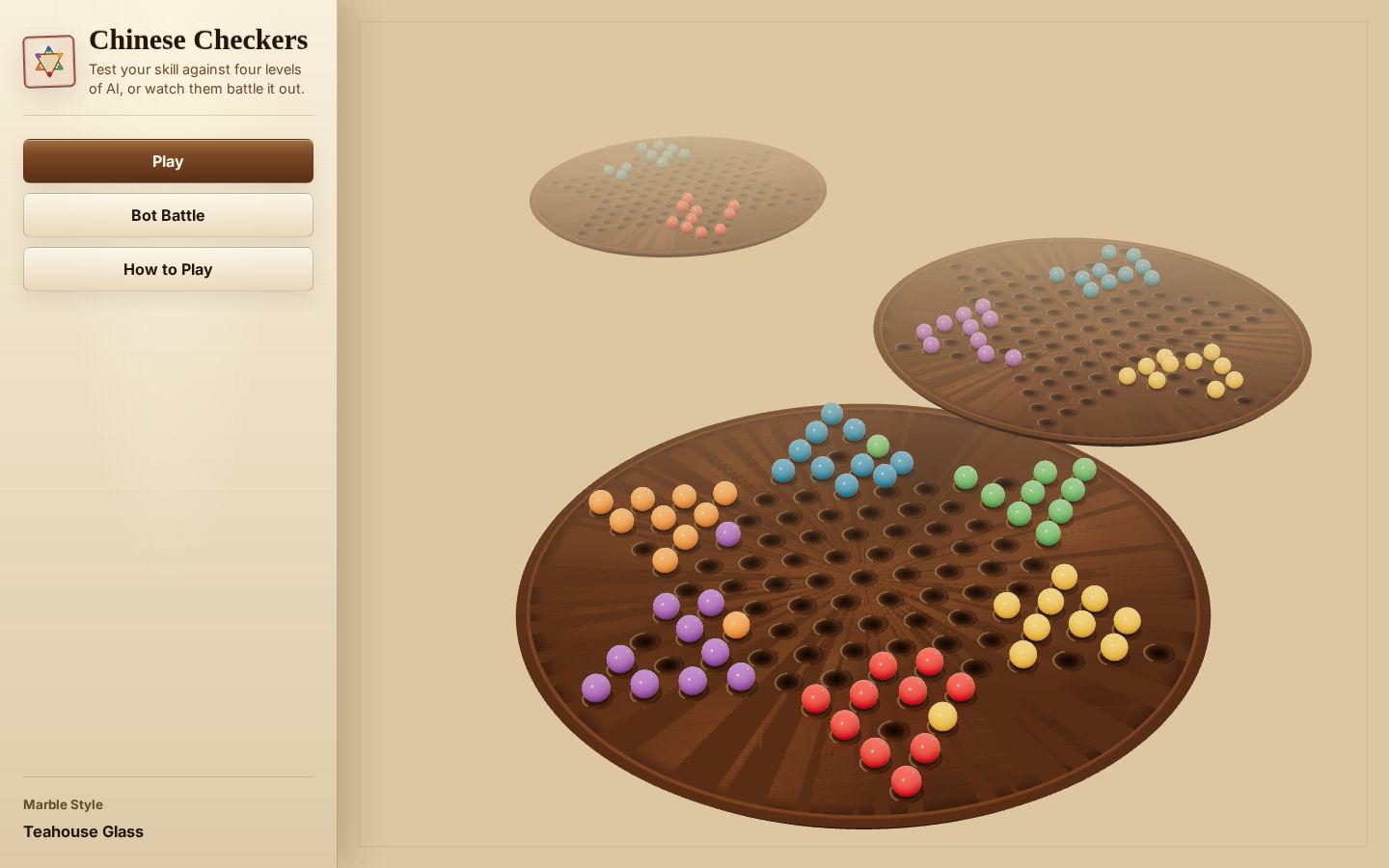
A from-scratch implementation of DeepMind’s AlphaZero algorithm, applied to Chinese Checkers: self-play training, Monte Carlo Tree Search, and a clean web interface. Play it live at chinesecheckers.xyz, with four levels of AI, or set the bots loose on each other.
Overview
This project explores the application of modern reinforcement learning techniques to Chinese Checkers, a classic strategy game with a branching factor that makes traditional minimax approaches computationally intractable.
The implementation follows the AlphaZero paradigm: a neural network learns to evaluate board positions and suggest moves entirely through self-play, without any human game knowledge beyond the rules. The result is a family of AI agents at various skill levels, from beginner-friendly to highly competitive.
Why Chinese Checkers?
Chinese Checkers presents unique challenges compared to games like Chess or Go:
- High branching factor: A single marble can chain multiple jumps, creating hundreds of possible moves per turn
- Multi-agent dynamics: Traditional Chinese Checkers supports 2-6 players, requiring different strategic considerations
- Asymmetric objectives: Players race to opposite corners, creating interesting tension between offensive progress and defensive blocking
- Sparse rewards: Games can last 50+ moves with the only reward signal at game end
Technical Architecture
Neural Network Design
The policy-value network uses a ResNet-inspired architecture optimized for the hexagonal board structure:
Input Layer (Board State Encoding)
    │
    ├── 121 hexagonal positions
    ├── Current player encoding
    ├── Move history (last 8 states)
    └── Valid move mask
    │
    ▼
Residual Tower (10 blocks)
    │
    ├── 128 filters per conv layer
    ├── Batch normalization
    └── ReLU activation
    │
    ├────────────┬────────────┤
    ▼            ▼
Policy Head   Value Head
    │            │
    ▼            ▼
Move Probs   Win Probability
(softmax)    (tanh: -1 to 1)
Key Design Decisions:
- Hexagonal convolutions: Custom convolutional kernels that respect the 6-neighbor topology of the Chinese Checkers board
- Jump sequence encoding: Moves are encoded as (start, end) pairs, with the network learning to evaluate multi-jump sequences
- Opponent modeling: For 2-player mode, the value head predicts win probability; for multiplayer, it outputs a ranking distribution
Monte Carlo Tree Search (MCTS)
The MCTS implementation includes several enhancements over vanilla UCT:
class MCTS:
    def search(self, root_state, num_simulations=800):
        """
        Perform MCTS with neural network guidance.

        Selection:  UCB1 with neural network prior
        Expansion:  Expand all children, evaluate with NN
        Backup:     Update Q-values along path
        """
        for _ in range(num_simulations):
            node = self.select(root_state)
            value = self.expand_and_evaluate(node)
            self.backup(node, value)

        return self.get_policy(root_state)
MCTS Enhancements:
| Feature | Purpose |
|---|---|
| Dirichlet noise | Adds exploration at root node during training |
| Progressive widening | Limits branching in high-action states |
| Virtual losses | Enables parallel tree search |
| Transposition table | Caches evaluations for repeated positions |
Training Pipeline
The self-play training loop follows the AlphaZero methodology:
┌─────────────────────────────────────────────────────────────┐
│                    Training Loop                             │
├─────────────────────────────────────────────────────────────┤
│                                                             │
│   ┌──────────┐    ┌──────────┐    ┌──────────┐            │
│   │ Self-Play │───▶│ Replay   │───▶│ Training │            │
│   │ Workers   │    │ Buffer   │    │ Worker   │            │
│   └──────────┘    └──────────┘    └──────────┘            │
│        │                               │                    │
│        │         ┌──────────┐         │                    │
│        └────────▶│ Model    │◀────────┘                    │
│                  │ Checkpoint│                              │
│                  └──────────┘                               │
│                       │                                     │
│                       ▼                                     │
│               ┌──────────────┐                             │
│               │  Evaluation  │                             │
│               │  (Elo Rating)│                             │
│               └──────────────┘                             │
│                                                             │
└─────────────────────────────────────────────────────────────┘
Training Statistics:
- Self-play games: ~500,000 games over training
- Training iterations: 200 iterations, ~2,500 games per iteration
- Hardware: 4x RTX 3090 for self-play, 1x A100 for training
- Total training time: ~72 hours
Game Features
AI Difficulty Levels
The trained models are checkpointed at various stages to provide a range of opponents:
| Level | Name | Elo | MCTS Sims | Description |
|---|---|---|---|---|
| 1 | Novice | 800 | 50 | Early training checkpoint. Makes obvious mistakes, good for learning. |
| 2 | Casual | 1200 | 100 | Plays reasonable moves but misses complex tactics. |
| 3 | Intermediate | 1600 | 200 | Solid positional play, occasional brilliant moves. |
| 4 | Advanced | 2000 | 400 | Strong tactical awareness, efficient pathing. |
| 5 | Expert | 2400 | 800 | Full-strength model. Will exploit any mistake. |
| 6 | Master | 2600+ | 1600 | Extended search. Nearly optimal play. |
Game Modes
vs AI (Single Player)
- Select difficulty from Novice to Master
- Undo/redo moves for learning
- Move hints showing AI’s top 3 suggestions
- Post-game analysis with AI evaluation graph
Local Multiplayer (Pass & Play)
- 2-player mode on a single device
- Automatic board rotation on turn change
- Optional move timer (30s, 1min, 2min, unlimited)
- Win animations and statistics
Online Multiplayer (planned)
- Real-time matches via WebSocket
- Ranked matchmaking with Elo system
- Spectator mode for ongoing games
User Interface Design
The UI draws inspiration from modern game platforms like chess.com and classic Flash/IO games, prioritizing:
Visual Design Principles
┌─────────────────────────────────────────────────────────────┐
│  ⚙️ Settings    Chinese Checkers AlphaZero    🏆 Stats      │
├─────────────────────────────────────────────────────────────┤
│                                                             │
│                    ┌─────────────┐                         │
│                    │   Board     │                         │
│                    │   Area      │                         │
│                    │             │                         │
│                    │    ⬡ ⬡ ⬡    │                         │
│                    │   ⬡ ⬡ ⬡ ⬡   │                         │
│                    │  ⬡ ⬡ ⬡ ⬡ ⬡  │                         │
│                    │             │                         │
│                    └─────────────┘                         │
│                                                             │
│  ┌──────────┐                          ┌──────────┐        │
│  │ Player 1 │                          │ Player 2 │        │
│  │ ●●●●●●   │                          │ ○○○○○○   │        │
│  │ Your Turn│                          │ AI: Exp  │        │
│  └──────────┘                          └──────────┘        │
│                                                             │
│         [↩️ Undo]  [💡 Hint]  [🔄 New Game]                  │
│                                                             │
└─────────────────────────────────────────────────────────────┘
Core UI Components
Game Board
- Smooth, responsive hexagonal grid
- Marble pieces with satisfying physics-based animations
- Valid move highlighting on piece selection
- Jump path visualization for multi-hop moves
- Subtle board texture with depth shadows
Piece Interactions
- Click-to-select, click-to-move (beginner-friendly)
- Drag-and-drop with snap-to-position
- Hover states showing piece ownership
- Selection glow effect with team color
Animations & Feedback
- Marble sliding animations with easing curves
- Jump chain animations (piece arcs over jumped positions)
- Capture/arrival celebrations (subtle particle effects)
- Turn transition with smooth board rotation (2P mode)
- Win sequence with fireworks and stats summary
Sound Design
- Satisfying “click” on piece selection
- Marble sliding sounds with pitch variation
- Distinct “hop” sound for jumps
- Ambient background music (toggleable)
- Victory fanfare
Settings Panel
┌─────────────────────────────────────┐
│         ⚙️ Settings                 │
├─────────────────────────────────────┤
│                                     │
│  🎮 Game                            │
│  ├─ AI Difficulty    [Advanced ▼]  │
│  ├─ Move Timer       [Off      ▼]  │
│  ├─ Show Hints       [●]           │
│  └─ Confirm Moves    [ ]           │
│                                     │
│  🎨 Appearance                      │
│  ├─ Board Theme      [Classic  ▼]  │
│  ├─ Piece Style      [Glass    ▼]  │
│  ├─ Animations       [●]           │
│  └─ Dark Mode        [●]           │
│                                     │
│  🔊 Audio                           │
│  ├─ Sound Effects    [●]  🔊━━━━○  │
│  ├─ Music            [ ]  🔊━━○━━  │
│  └─ Voice Lines      [ ]           │
│                                     │
│  📊 Stats                           │
│  ├─ Games Played: 47               │
│  ├─ Win Rate: 62%                  │
│  └─ Best Win: vs Expert            │
│                                     │
│           [Reset Stats]             │
│                                     │
└─────────────────────────────────────┘
Theme Options
| Theme | Description |
|---|---|
| Classic | Traditional wooden board with glass marbles |
| Neon | Dark background with glowing pieces (IO game style) |
| Minimal | Clean whites and blacks, subtle shadows |
| Nature | Earthy tones, stone-like pieces |
| Retro | Pixel art style, 8-bit sound effects |
Implementation Details
Tech Stack
Frontend
- React 18 with TypeScript
- Canvas/WebGL for board rendering (via PixiJS)
- Framer Motion for UI animations
- Zustand for state management
- Howler.js for audio
Backend
- Python FastAPI for game server
- PyTorch for model inference
- Redis for session management
- WebSocket for real-time communication
AI Engine
- ONNX Runtime for optimized inference
- Web Worker isolation for non-blocking AI computation
- Configurable search depth per difficulty level
Performance Optimizations
// Move generation with bitboard optimization
class MoveGenerator {
  // Precomputed jump tables for instant lookup
  private jumpTable: Map<number, number[]>;

  generateMoves(state: GameState): Move[] {
    const moves: Move[] = [];

    // Single steps: O(1) lookup per piece
    for (const piece of state.currentPlayerPieces) {
      moves.push(...this.singleSteps[piece]);
    }

    // Jump chains: BFS with visited tracking
    for (const piece of state.currentPlayerPieces) {
      this.generateJumpChains(piece, moves, new Set());
    }

    return moves;
  }
}
Optimization Results:
| Metric | Before | After |
|---|---|---|
| Move generation | 12ms | 0.3ms |
| Board evaluation | 8ms | 0.1ms |
| AI move (Expert) | 5s | 1.2s |
| Memory usage | 180MB | 45MB |
Development Roadmap
Completed
- Core AlphaZero implementation
- Self-play training pipeline
- 6 difficulty levels with distinct personalities
- Web-based game interface
- Local 2-player mode
- Move hints and undo system
- Settings persistence
In Progress
- Post-game analysis with move-by-move AI evaluation
- Board themes and piece customization
- Sound effects and music
Planned
- Online multiplayer with matchmaking
- Tournament mode
- Mobile-responsive design
- Opening book integration
- Endgame tablebase for perfect play
Research Insights
What the AI Learned
Through self-play, the AI discovered several strategic principles:
- Center control: Strong models prioritize occupying central hexes early, maximizing jump opportunities
- Chain building: Creating “highways” of pieces that enable long jump sequences
- Blocking tactics: Strategically leaving pieces to obstruct opponent paths
- Tempo management: Understanding when to make small advances vs. waiting for big jumps
Training Curves
The model’s strength (measured in Elo) evolved through distinct phases:
Elo
2600 │                                    ══════════
     │                              ═════╝
2200 │                        ═════╝
     │                  ═════╝
1800 │            ═════╝
     │      ═════╝
1400 │ ════╝
     │
1000 └──────────────────────────────────────────────
     0        50       100      150      200
                   Training Iterations
- Iterations 0-30: Learning basic piece movement
- Iterations 30-80: Discovering jump chains
- Iterations 80-150: Positional understanding
- Iterations 150+: Tactical refinement, diminishing returns
Try It Yourself
Play online at chinesecheckers.xyz: pick from four levels of AI, or watch them battle it out in bot-battle mode.
Acknowledgments
- DeepMind’s AlphaZero paper for the foundational algorithm
- Leela Chess Zero community for distributed training insights
- chess.com for UI/UX inspiration
Built with curiosity and too many late nights. If you enjoy the game, consider starring the repo!